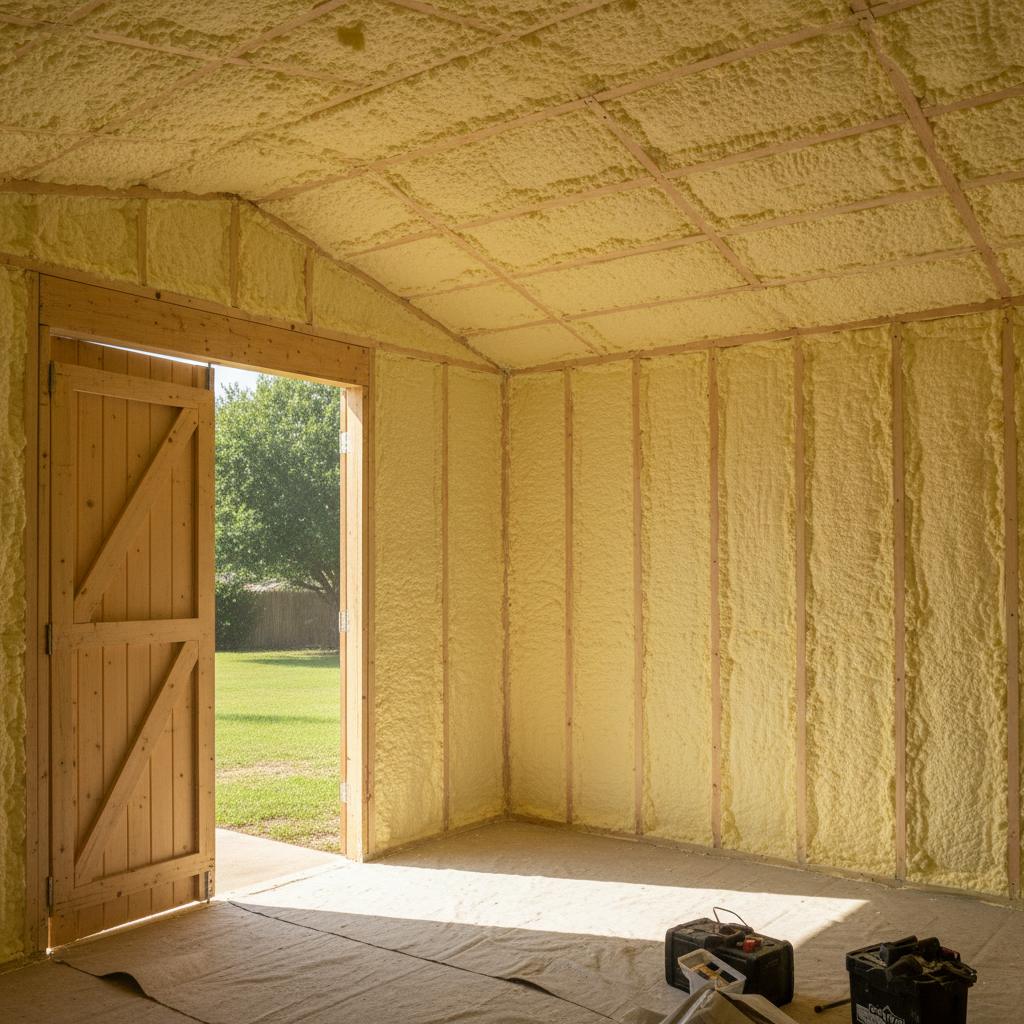
You're probably wondering what it's going to cost to insulate that shed out back. It's not just about making it comfortable for your hobbies or storage; it's about protecting your stuff from our Texas heat and those occasional cold snaps. I've been doing this for a while here in Waxahachie, and I can tell you, while every job is a little different, there are some pretty clear cost ranges you can expect.
What Makes the Price Tag Change?
A few things really push the cost up or down when you're looking at shed insulation. It's not just a flat rate per square foot like some folks think. Here's what we look at:
- Shed Size: This is obvious, right? A small 8x10 garden shed is going to cost a lot less to insulate than a 12x24 workshop. More area means more material and more labor.
- Insulation Type: This is a big one. You've got options like fiberglass batts, rigid foam boards, or spray foam. Fiberglass is usually the cheapest upfront, but it's not always the best for sheds because it can hold moisture if not installed perfectly, especially with our humidity. Rigid foam is good, but spray foam, while pricier, gives you the best seal against air leaks and pests. For a typical 10x12 shed, you might be looking at around $400-$700 for fiberglass, $700-$1,200 for rigid foam, and $1,200-$2,000 for open-cell spray foam. Closed-cell spray foam would be even higher, maybe $1,800-$3,000, but it's often overkill for a basic shed unless you're storing something really sensitive.
- Wall & Ceiling Structure: If your shed's got open studs and rafters, it's a lot easier and faster to install insulation. If it's already got some kind of finished interior or a bunch of shelves in the way, we'll have to work around that, and that adds time and labor.
- Accessibility: Can we easily get to all parts of the shed? Is it tucked away in a tight corner of your backyard, or is it out in the open? This affects how long the job takes.
- Existing Conditions: Does the shed need any prep work? Are there holes that need sealing first? Is there old, soggy insulation that needs to be removed? That's an extra cost, usually charged by the hour or by the amount of debris.
- Ventilation: Proper ventilation is key, especially in our climate. Sometimes we'll recommend adding vents to prevent moisture buildup, which is a small added cost but a big benefit.
Typical Cost Ranges for Waxahachie Sheds
Alright, let's get down to some numbers. For a standard backyard shed here in Waxahachie, say a 10x12 or 12x16, you're generally looking at:
- Basic Fiberglass Batts: Expect to pay roughly $600 to $1,000. This is for walls and ceiling, installed. It's a decent option if you're on a tight budget and your shed is pretty well sealed already.
- Rigid Foam Boards: This will usually run you about $1,000 to $1,800. It's a step up in performance and moisture resistance.
- Open-Cell Spray Foam: For the best air seal and temperature control, you're probably looking at $1,800 to $2,800. This is what I often recommend for sheds that are going to be used as offices, workshops, or for storing sensitive items. It really makes a difference, especially when that Waxahachie sun is beating down all summer.
Remember, these are ballpark figures. The exact cost will depend on the factors I just mentioned and the specific R-value you're aiming for.
What Should a Good Quote Include?
When you get a quote from Mighty Insulation, or anyone else for that matter, make sure it's clear. It should detail:
- The type of insulation being used (e.g., R-13 fiberglass, 2-inch open-cell spray foam).
- The areas being insulated (walls, ceiling, sometimes the floor if it's raised).
- Any necessary prep work, like sealing gaps or removing old material.
- The total cost, including labor and materials.
- A timeline for completion.
- A warranty on the work, if applicable.
Don't just go for the cheapest number. Understand what you're getting for your money.
How to Avoid Overpaying
My best advice? Get a few quotes. Don't just take the first one that comes along. Make sure each contractor comes out to your property and actually looks at your shed. Someone trying to give you a quote over the phone without seeing the job site isn't going to be accurate, and you'll likely end up with surprises. Ask questions. A good contractor, like us at Mighty Insulation, will be happy to explain everything and help you understand your options without pushing you into something you don't need.
Also, consider the long-term value. Cheaper insulation might save you a few bucks upfront, but if it doesn't perform well, or if it leads to moisture issues, you'll be spending more in the long run. Especially around here, with our expansive clay soils and the way things can shift, you want an insulation that's going to hold up and seal well.
Insulating your shed is a smart move. Just make sure you're getting the right solution for your needs and your budget.